
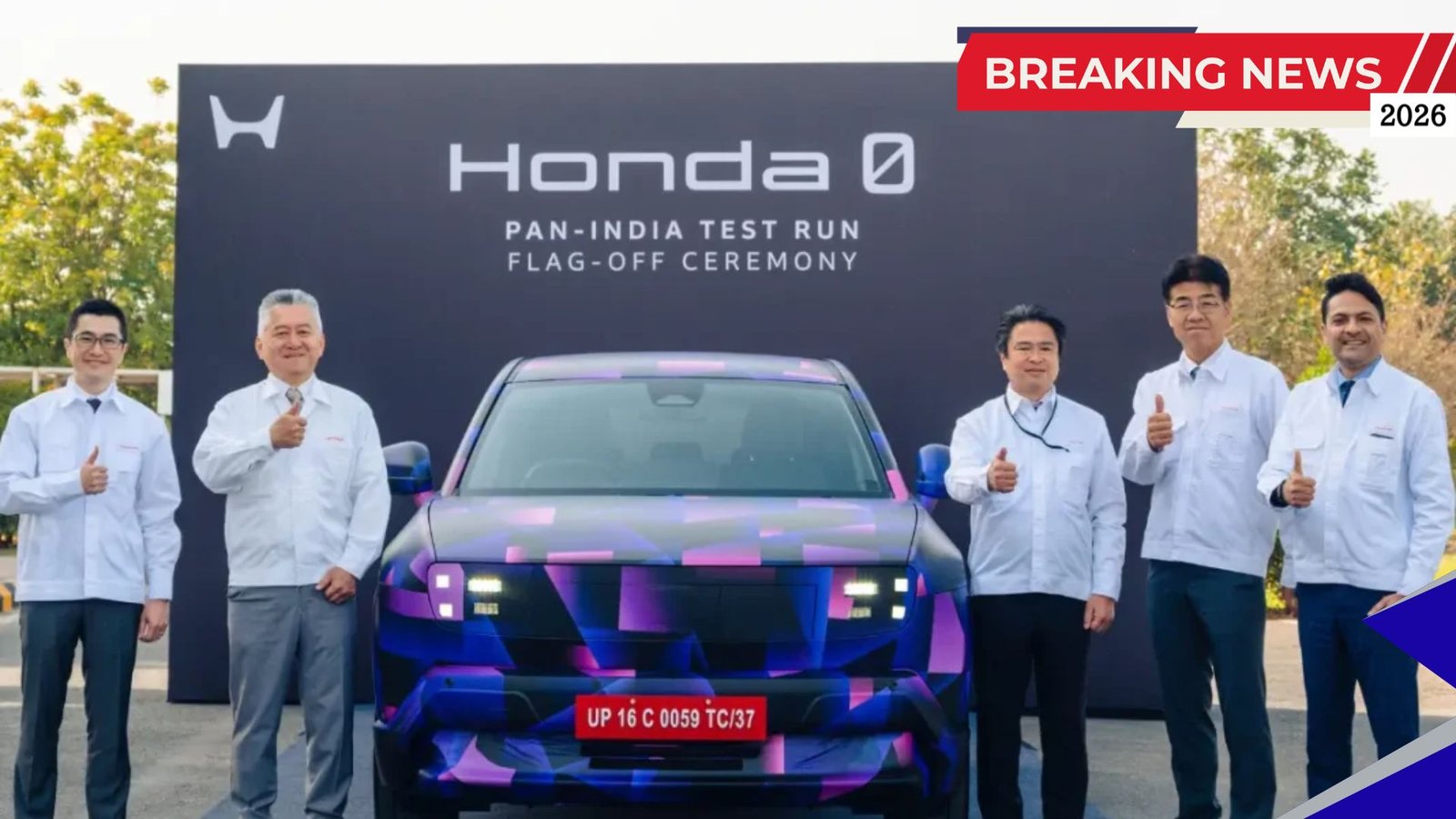
Honda Cars India has started extensive road testing of the upcoming Honda 0 Alpha SUV across different parts of the country. The electric SUV was first showcased in concept form at the Japan Mobility Show last year and is set to become the company’s first battery electric vehicle (BEV) offering for the Indian market.
The ongoing testing programme will evaluate the vehicle’s performance under diverse driving conditions, including city traffic, highways, and challenging terrain. This phase is considered an important step in preparing the model for its planned launch in the financial year 2026–27.
Pan-India Testing to Validate Real-World Performance
Honda’s testing initiative aims to assess how the Honda electric SUV testing India programme performs in real-world usage scenarios. Engineers are analysing factors such as ride quality, efficiency, battery behaviour, and overall durability in different environments.
By conducting trials across varied road conditions and climates, the company intends to ensure that the vehicle meets expectations related to reliability and usability. Such comprehensive validation is common for new electric vehicles, particularly when they are being introduced in markets with diverse terrain and infrastructure.
This testing phase also allows Honda to refine vehicle settings and features before moving toward production readiness.
Production Plans and Investment Strategy
The upcoming Honda 0 Alpha SUV will be manufactured at the company’s Tapukara facility in Rajasthan. This plant is expected to play a key role in Honda’s electrification strategy, as the vehicle will be produced for both domestic sales and export markets.
To support EV production, the automaker has planned an investment of nearly Rs 12,000 crore. This large-scale financial commitment highlights Honda’s intention to strengthen its presence in the electric mobility space.
India and Japan are expected to be among the first countries where the new electric SUV will be introduced, further underlining the importance of these markets in Honda’s global EV roadmap.
Design Direction Inspired by Concept Model
The production-spec version of the Honda 0 Alpha SUV is likely to retain several styling elements from the concept. The vehicle is expected to follow Honda’s ‘Thin, Light and Wise’ design philosophy, which focuses on efficiency and modern aesthetics.
Design highlights may include an upright and wide stance that enhances road presence. A uniquely styled front grille with an illuminated Honda logo is also anticipated, along with a sharply raked windscreen that contributes to aerodynamic efficiency.
Other exterior features could include aero-optimised 19-inch alloy wheels and prominent wheel arches that add to the SUV’s muscular character. At the rear, the model is expected to feature a vertical windscreen design and full-width U-shaped tail lamps.
Expected Exterior Design Elements
| Feature Area | Anticipated Detail |
|---|---|
| Front Styling | Illuminated logo and distinctive grille |
| Wheels | Aero-optimised 19-inch alloys |
| Charging Port | Side-mounted placement |
| Rear Lighting | Full-width U-shaped tail lamps |
| Stance | Upright and wide body proportions |
These design cues suggest that the SUV will aim to combine visual appeal with functional efficiency.
Spacious Cabin Expected with Long Wheelbase
Although full interior details remain undisclosed, Honda officials have indicated that the electric SUV will feature a wheelbase in the range of approximately 2,700mm to 2,800mm. This extended dimension is expected to improve cabin space and passenger comfort.
A longer wheelbase typically contributes to better legroom and overall interior practicality, particularly in SUVs positioned for family use or long-distance travel. Such structural advantages may help the vehicle compete more effectively in the mid-size electric SUV segment.
By prioritising interior roominess, Honda appears to be focusing on both comfort and usability for Indian customers.
Battery Options Likely to Include LFP Packs
The Honda electric SUV testing India programme is also evaluating the performance of lithium iron phosphate (LFP) battery packs. The upcoming model is expected to be offered with two battery options, with capacities likely to range between 65kWh and 75kWh.
While official range figures and charging specifications have not yet been revealed, this battery capacity band suggests a focus on delivering practical driving range suitable for urban commuting and highway journeys.
Offering multiple battery choices can help buyers select a variant that best suits their usage requirements and budget considerations.
Expected Pricing and Segment Competition
When launched, the Honda 0 Alpha SUV is expected to be priced from around Rs 25 lakh for the entry-level variant. This positioning places it in the competitive mid-size electric SUV segment.
The model is likely to compete with several established and upcoming EVs, including the Mahindra BE 6, Hyundai Creta Electric, Maruti e Vitara, Tata Curvv EV, MG ZS EV, and the forthcoming Toyota E-bella.
Such competition reflects the rapid expansion of India’s electric vehicle market, where manufacturers are introducing new models across multiple price ranges.
Key Expected Highlights
- First battery electric vehicle offering from Honda in India
- Pan-India testing programme underway before production launch
- Manufacturing planned at Tapukara plant in Rajasthan
- Likely LFP battery options between 65kWh and 75kWh
- Expected starting price around Rs 25 lakh
These points indicate the strategic importance of the upcoming model in Honda’s electrification journey.
Conclusion: What the Testing Phase Means for Buyers and the EV Market
The start of road trials for the Honda 0 Alpha SUV marks a significant milestone in Honda’s entry into India’s electric passenger vehicle segment. By conducting extensive testing and planning large investments in EV manufacturing, the company is preparing to introduce a globally relevant electric SUV tailored for Indian conditions.
This development matters because it signals increasing competition and innovation in the electric SUV space. Buyers should understand that while the vehicle is still under evaluation, its launch in FY2026–27 could expand choices for customers seeking mid-range electric mobility solutions.
Going forward, the progress of testing and subsequent announcements will be closely watched as the Indian EV market continues to evolve.