
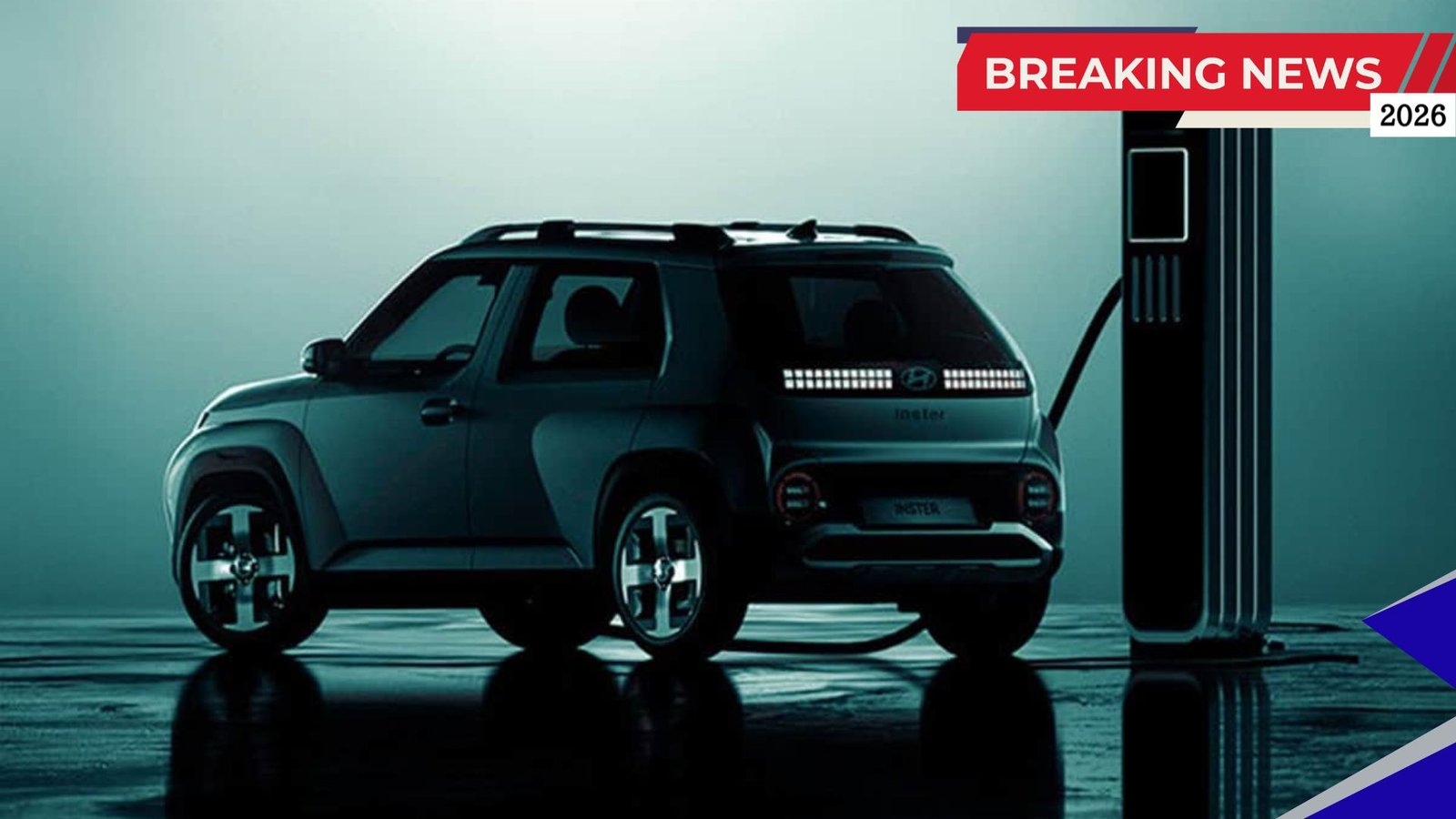
Hyundai is preparing to introduce a new locally developed electric compact SUV for the Indian market, with launch plans targeting 2027. The upcoming model, widely referred to as the Hyundai compact EV, is expected to be designed, engineered, and manufactured in India, highlighting the company’s growing focus on localisation and electric mobility.
This new electric vehicle is likely to measure under four metres in length and will directly compete with established entry-level EVs such as the Tata Punch EV. The development marks an important step in Hyundai’s broader electrification strategy for India.
Production to Take Place at Sriperumbudur Facility
The new Hyundai compact EV will be produced at the company’s manufacturing plant in Sriperumbudur, Tamil Nadu. This facility will serve as the primary hub for both domestic sales and potential export markets.
Hyundai has also confirmed that it plans to use locally sourced battery packs supplied by Exide Industries. This move is part of the company’s effort to build a more localised supply chain for electric vehicles in India, which could help improve cost efficiency and production scalability.
By increasing localisation, Hyundai aims to strengthen its competitiveness in the rapidly expanding EV segment.
Codename HE1i and Possible Inster-Based Platform
Internally codenamed HE1i, the upcoming electric SUV could be based on the global-spec Hyundai Inster EV. The model is expected to use the scalable E-GMP (Electric Global Modular Platform), which supports advanced EV technologies.
This platform is capable of enabling high-speed 800V charging capability and is designed to deliver strong driving range performance. Hyundai has indicated that the new compact EV will be offered with two battery pack options, giving buyers flexibility based on usage needs.
Such modular architectures allow manufacturers to adapt vehicles to different markets while maintaining technological consistency.
Battery Options and Expected Range Details
Globally, the Hyundai Inster EV is available with two battery choices — a 42kWh standard range pack and a 49kWh long-range unit. These configurations deliver a claimed WLTP driving range of approximately 300km and 355km respectively.
The smaller battery version is paired with an electric motor producing around 97bhp and 147Nm of torque. The larger battery variant offers about 115bhp while maintaining similar torque output.
While exact specifications for the India-bound model have not been officially confirmed, these global figures provide an indication of the performance potential expected from the Hyundai Inster EV India-based compact SUV.
Expected Battery and Performance Overview
| Battery Option | Claimed Range (WLTP) | Power Output | Torque |
|---|---|---|---|
| 42kWh | Around 300 km | 97 bhp | 147 Nm |
| 49kWh | Around 355 km | 115 bhp | 147 Nm |
These options suggest that the vehicle will aim to balance efficiency and practicality for urban commuting.
Advanced Features Likely to Be Offered
Hyundai has confirmed that the new compact EV will feature a Level 2 Advanced Driver Assistance System (ADAS) suite. This technology is expected to support safer driving by assisting with functions such as collision avoidance and lane monitoring.
The infotainment system is also likely to support over-the-air (OTA) updates, enabling continuous software improvements without requiring frequent service visits. Based on the global Inster EV, the India-bound model could include a dual-screen dashboard setup, automatic climate control, in-car connectivity technology, and a 360-degree camera with blind-spot monitoring.
These features indicate Hyundai’s intention to offer a well-equipped product even in the entry-level electric SUV category.
Strong Focus on Localisation Strategy
Hyundai is working to establish a highly localised EV ecosystem in India. The plan includes sourcing battery cells locally and collaborating with domestic suppliers for key components such as electric powertrain systems and sub-assemblies.
Such localisation efforts can help reduce production costs and improve supply chain resilience. This strategy also aligns with broader industry trends where manufacturers are investing in regional manufacturing capabilities to support long-term EV adoption.
By developing vehicles specifically for Indian conditions, Hyundai aims to enhance product relevance and market acceptance.
Part of Hyundai’s Larger India Product Plan
The introduction of the Hyundai compact EV is part of a broader product roadmap announced by the company. Hyundai plans to launch a total of 26 new models in India by 2030.
According to the plan, four new products are expected by 2026, followed by eight models during the financial years 2027–2028. A further fourteen vehicles are planned between FY2029 and FY2030.
This aggressive rollout strategy highlights Hyundai’s commitment to expanding its presence across multiple segments, including electric mobility.
Hyundai India Product Rollout Timeline
| Period | Planned New Models |
|---|---|
| By 2026 | 4 models |
| FY2027–2028 | 8 models |
| FY2029–2030 | 14 models |
Such long-term planning underscores the company’s intent to remain competitive in a rapidly evolving automotive market.
Conclusion: What the Upcoming Compact EV Means for Indian Buyers
The confirmation of a locally developed Hyundai compact EV signals a significant move in the brand’s electrification journey in India. With plans for local manufacturing, multiple battery options, and modern safety and connectivity features, the upcoming SUV is expected to play an important role in expanding EV choices in the under-4-metre segment.
This development matters because it highlights growing competition in the entry-level electric SUV space, where affordability and practicality remain key factors for buyers. Customers should understand that the model is still under development, with its launch targeted for 2027.
Going forward, Hyundai’s localisation strategy and planned product expansion could influence how quickly electric vehicles gain wider acceptance in India.