
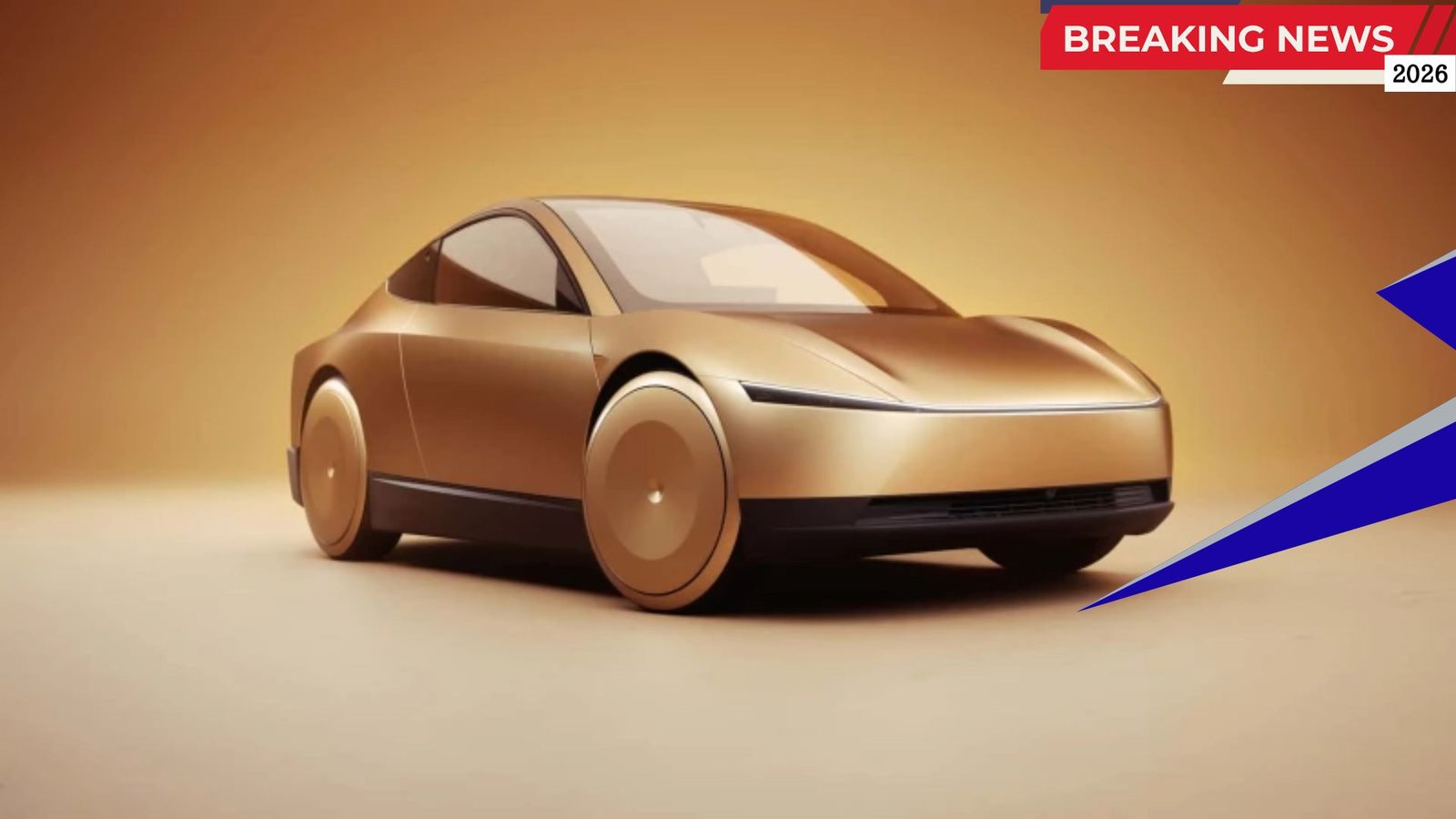
Tesla has marked a significant milestone with the first Tesla Cybercab rolling off the production line at its Gigafactory in Texas. The upcoming autonomous taxi represents a major shift in how ride-hailing vehicles could operate in the future. Notably, the vehicle has been designed without a steering wheel or pedals and is intended to function entirely through the company’s Full Self-Driving (FSD) technology.
According to Tesla CEO Elon Musk, production of the Cybercab is scheduled to begin in April, suggesting that the company is progressing in line with previously announced timelines. However, the development also raises questions about technological readiness, regulatory approvals, and manufacturing challenges as Tesla prepares for larger-scale rollout.
A New Concept of Taxi Without Steering or Pedals
The Cybercab introduces a radically different concept compared to traditional taxis. Tesla is positioning it as a fully autonomous commercial vehicle capable of transporting passengers without human intervention. With no steering wheel or pedals included in the design, the vehicle will depend entirely on Tesla’s self-driving software to operate.
This approach could reshape urban transportation if successfully implemented. The vehicle is expected to be a compact, two-seater taxi primarily intended for ride-hailing services. While private ownership is also anticipated as an option, its core function is expected to revolve around autonomous taxi operations.
Unlike many competitors in the autonomous driving sector, Tesla’s system relies on cameras combined with artificial intelligence rather than LiDAR sensors. This camera-based vision system forms the backbone of the company’s strategy to achieve full autonomy.
Battery, Range and Charging Specifications
Tesla is expected to equip the Tesla Cybercab with a relatively small battery pack compared to many modern electric vehicles. Reports indicate that the vehicle will feature a 35-kWh battery designed to deliver efficient urban mobility and cost-effective operations.
Here is a quick overview of the expected specifications:
| Feature | Expected Details |
|---|---|
| Battery Capacity | 35 kWh |
| Driving Range | Around 200 miles (322 km) |
| Charging Method | Inductive (wireless) charging |
| Seating Capacity | Two passengers |
| Estimated Price | Under $30,000 |
The use of inductive charging could enable automated charging cycles, allowing fleets of Cybercabs to operate continuously without manual intervention.
Production Timeline and Manufacturing Method
Tesla plans to begin full production of the Cybercab in April this year. The company is reportedly using a new manufacturing strategy called the “Unboxed” production method for the vehicle.
This system differs from traditional assembly lines by building separate modules in different factory zones before combining them during final assembly. The concept aims to reduce manufacturing costs, save factory space, and significantly speed up production.
Elon Musk has compared this production approach to how consumer electronics are manufactured. Tesla has projected a potential production cycle time of one vehicle every 10 seconds under optimal conditions. However, the company has also indicated that early manufacturing stages could progress slowly as teams adjust to the new system.
Current Challenges With Full Self-Driving Technology
While the Full Self-Driving (FSD) system is central to the Cybercab project, reports suggest that Tesla still faces significant challenges in achieving fully autonomous driving without human oversight.
Tesla’s existing robotaxi pilot program currently uses Model Y vehicles as test platforms. These vehicles operate with Level 2 driver assistance systems, which still require active human supervision. This level of autonomy is far below Level 5, the standard required for vehicles like the Cybercab to operate independently.
In Austin, where the pilot program is being tested, reports indicate that around 14 crashes have occurred over an eight-month period. This figure is said to be nearly four times higher than Tesla’s benchmark comparisons involving human drivers.
These incidents highlight the gap between current driver assistance technology and the fully autonomous capabilities that the Cybercab is expected to demonstrate.
Previous Hardware Decisions and Technology Readiness
Tesla’s approach to introducing new technologies has sometimes involved making hardware changes before supporting software systems were fully developed. For instance, the company removed ultrasonic sensors from its vehicles in 2022 and earlier eliminated radar systems from certain models in 2021.
These decisions reportedly led to concerns within the company and were associated with reports of increased collision risks, near-miss incidents, and phantom braking events. The Cybercab’s reliance on camera-only perception technology continues this strategic direction.
The absence of manual driving controls also means that if software systems malfunction, passengers would not be able to take over driving duties.
Regulatory and Branding Challenges Ahead
Before the Cybercab can operate widely on public roads, Tesla must address regulatory requirements. Current US Federal Motor Vehicle Safety Standards mandate safety equipment such as steering wheels in vehicles. Since the Cybercab does not include such components, Tesla is reportedly seeking exemptions from these regulations.
In addition to regulatory issues, the company is also facing uncertainty related to branding. Reports suggest there is an ongoing trademark dispute with a French beverage company over the “Cybercab” name. This could result in the vehicle being launched under a different name when it finally reaches commercial markets.
Competition and Market Strategy
Tesla’s autonomous taxi initiative is expected to compete directly with established robotaxi services such as Waymo. The company is also likely to target major ride-hailing platforms like Uber and Lyft, positioning the Cybercab as a cost-efficient mobility solution.
With an expected price of under $30,000, Tesla appears to be focusing on affordability and scalability. The aim is to make autonomous taxi fleets economically viable for operators while potentially reducing transportation costs for passengers.
Conclusion
The rollout of the first Tesla Cybercab from the production line signals a major step in Tesla’s vision for autonomous mobility. Designed without steering controls and built around the company’s Full Self-Driving (FSD) system, the vehicle represents a bold attempt to redefine how taxis and ride-hailing services function.
However, several challenges remain before full-scale production begins in April. These include achieving reliable unsupervised autonomy, navigating regulatory approvals, refining new manufacturing processes, and resolving branding disputes.
How Tesla addresses these issues will play a key role in determining whether the Cybercab becomes a transformative breakthrough in transportation or another ambitious technological goal still in progress.