
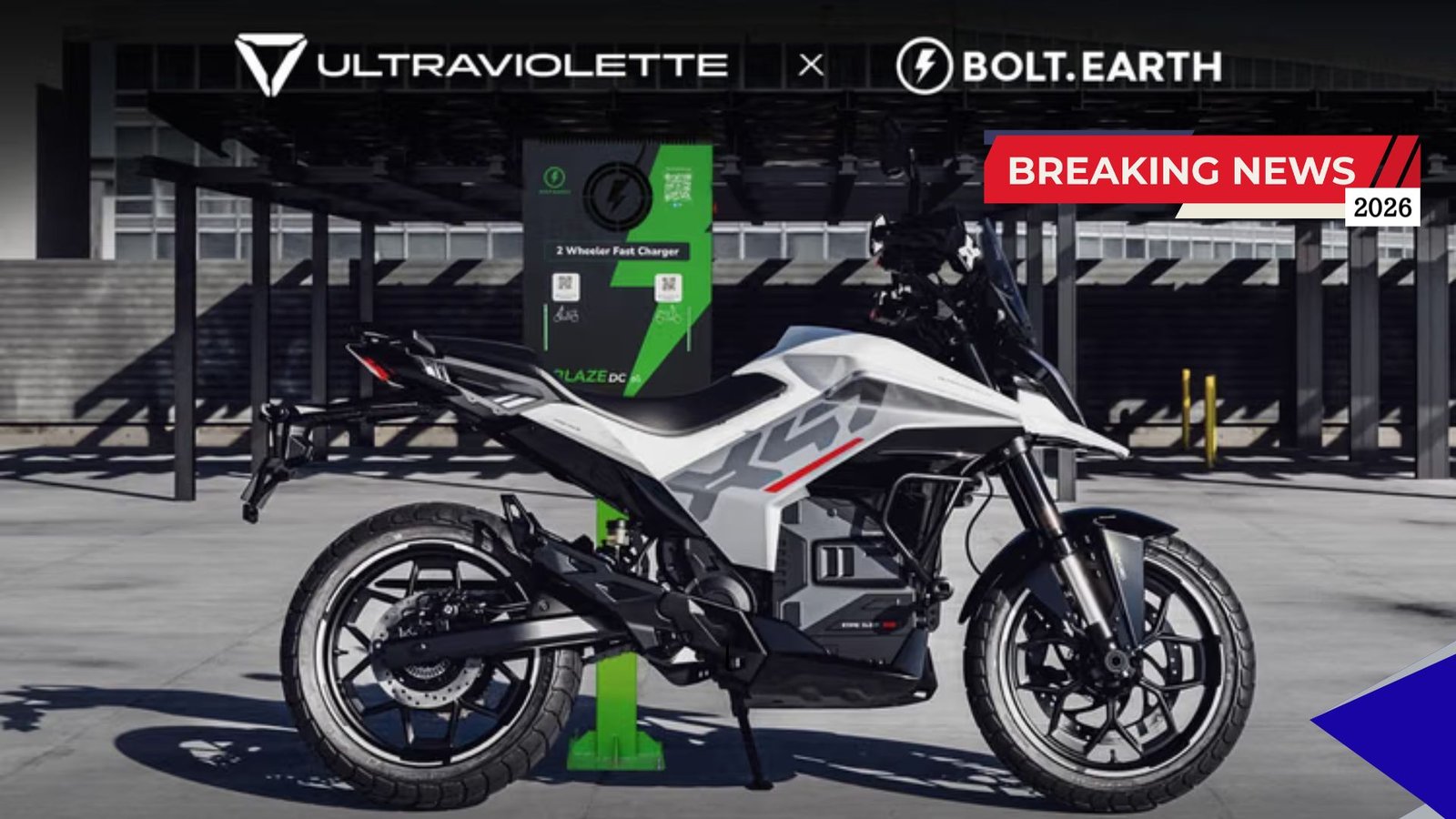
Electric motorcycle manufacturer Ultraviolette has announced a strategic partnership with EV charging network operator Bolt.Earth to deploy a nationwide network of Type-6 DC fast chargers. The initiative aims to expand interoperable fast-charging infrastructure for light electric vehicles, including two-wheelers and three-wheelers, across multiple Indian states.
Public charging stations under this collaboration are already operational in Kerala, Maharashtra, Telangana, Karnataka, Delhi, Gujarat, and Tamil Nadu. The rollout represents a significant step toward aligning electric vehicle design with India’s national charging standards while encouraging wider infrastructure adoption.
Nationwide Rollout Plans and Deployment Targets
The charging network expansion includes chargers installed at locations identified by Ultraviolette. The companies plan to upgrade the network to 50 stations within the next two months.
Bolt.Earth has committed to deploying 2,000 Type-6 fast chargers over a 24-month period. The goal is to build one of India’s largest public fast-charging networks tailored specifically for advanced electric two-wheelers.
This planned deployment is expected to support the increasing adoption of high-performance electric motorcycles and other light EVs across urban and intercity routes.
Charging Compatibility and Performance Details
All newly installed Bolt.Earth DC chargers will be compatible with Ultraviolette’s current and upcoming vehicle lineup without requiring any hardware modifications.
The 3 kW DC chargers introduced under the partnership can charge Ultraviolette’s X-47 and F77 motorcycles from zero to 80 percent in around 2.5 hours. A full charge from zero to 100 percent can be completed in approximately 3.5 hours.
In addition, Bolt.Earth plans to introduce higher-capacity Blaze DC chargers in 6 kW and 12 kW configurations. These chargers are intended for deployment along busy urban corridors and high-density mobility routes where faster turnaround times are necessary.
Type-6 Standard and Interoperability Focus
The collaboration is centred on the Type-6 DC charging interface, which is India’s recognised national standard for light electric vehicles. Formally published by the Bureau of Indian Standards as IS 17017 (Part 2/Section 6), the standard covers a wide range of vehicles.
These include e-bikes, electric scooters, motorcycles, e-rickshaws, delivery vehicles, tricycles, and electric all-terrain vehicles. The standard has also been adopted internationally as IEC 62196-6, indicating its relevance beyond India’s domestic EV market.
Ultraviolette has designed its vehicles around the Type-6 interface. The company states that adopting an open and standards-based charging connector helps improve interoperability and reduces reliance on proprietary charging systems that can slow infrastructure development.
Mobile App Integration and Safety Features
Riders will be able to locate charging stations, monitor charging sessions remotely, and make payments through the Ultraviolette and Bolt.Earth mobile applications. A scan-to-pay system has been integrated to simplify the charging experience.
The chargers include multiple safety mechanisms designed to meet industrial reliability standards. These features include:
- Short-circuit protection
- Over-voltage and under-voltage protection
- Reverse polarity protection
- Earth fault detection
- Emergency push button functionality
Such safety architecture aims to ensure consistent performance across diverse operating environments.
Addressing Charging Infrastructure Challenges in India
India’s electric two-wheeler market has grown significantly in recent years due to factors such as government incentives under schemes like FAME and rising fuel prices. However, public charging infrastructure — especially DC fast-charging options — has not expanded at the same pace as vehicle adoption.
Industry stakeholders have often highlighted the absence of a widely accepted connector standard as a major obstacle. Limited interoperability between charging networks can discourage third-party investment and create inconvenience for EV riders.
The rollout of Type-6 chargers is being positioned as a solution to this fragmentation. Standardisation is expected to support broader infrastructure development and improve user confidence in electric mobility.
Bolt.Earth Network Capabilities and Expansion
Founded in 2017, Bolt.Earth has evolved from an IoT solutions provider into a vertically integrated EV charging network operator. The company currently runs more than 100,000 chargers across over 1,900 cities in India.
Its operations span hardware manufacturing, software deployment, and network management services. The company’s proprietary Charger Management System enables charger owners to monitor performance and generate passive income through an open platform model.
The partnership with Ultraviolette is expected to further strengthen Bolt.Earth’s presence in the fast-charging segment for light electric vehicles.
Ultraviolette’s Market Presence and Global Reach
Ultraviolette, established in 2016, has expanded its operations with support from investors including TVS Motor Company, Qualcomm Ventures, TDK Ventures, Zoho Corporation, Lingotto, and Speciale Invest.
The company became the first Indian electric motorcycle manufacturer to receive European certification and currently exports its products to 12 countries. These include Germany, France, the United Kingdom, Spain, and Italy.
The charging network partnership follows the launch of the X-47 motorcycle and coincides with Ultraviolette’s ongoing expansion of its domestic retail footprint.
Conclusion
The collaboration between Ultraviolette and Bolt.Earth to roll out a nationwide Type-6 fast-charging network represents an important development in India’s electric mobility ecosystem. By focusing on interoperable charging infrastructure based on a national standard, the initiative aims to address key challenges related to accessibility and network compatibility.
With plans to deploy thousands of chargers and introduce higher-capacity units for faster charging, the partnership highlights growing industry efforts to support the next phase of EV adoption. As electric two- and three-wheelers continue to gain traction across India, improved fast-charging availability is expected to play a crucial role in shaping user experience and long-term market growth.